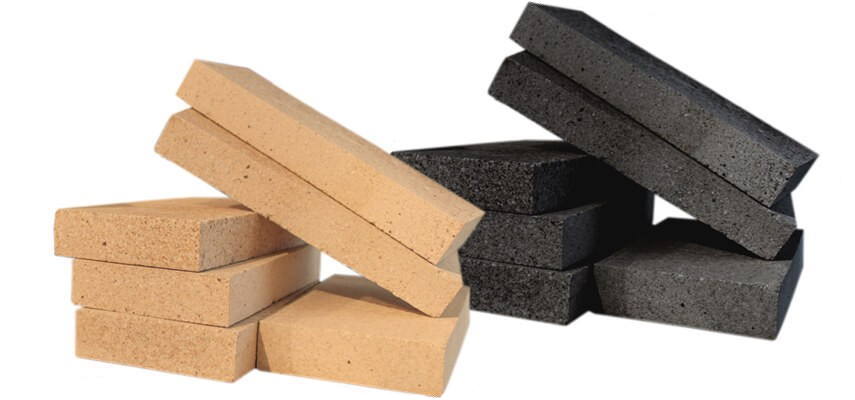
Choose firebricks for a garden fire pit according to their position in the construction. The lining beside the fuel and flame has a different role from the decorative outer masonry. Establish whether a layer needs heat storage or reduced heat transfer: dense firebrick and lightweight insulation are different materials.
Check the material and nominal dimensions
Vitcas firebrick is intended for compatible high-temperature construction. Colour alone does not determine suitability. Consider the format, thickness, support and intended fuel.
Lay out several courses before ordering the full quantity. Manufacturing tolerances mean the actual arrangement needs a dry-fit check. Plan cuts so that small pieces retain the support required by the design.
Account for joints and heat flow
Joint thickness follows the design and mortar instructions. Do not compensate for large dimensional differences with an arbitrary thick joint. Outdoor Oven Cement is an example of a material for correctly specified exterior firebrick joints.
Dense refractory masonry stores heat, but does not guarantee a cool outside face. External temperature depends on the complete section, insulation and operating conditions. Check separation from surrounding features and the movement allowance for components that expand during heating.
Plan water exposure and use
Consider drainage, protection while the fire pit is unused and drying after prolonged wetting. A heat rating does not justify rapidly firing wet masonry. Before first use, meet the drying requirements of the complete material arrangement.
If a brick will form a surface in direct contact with food, confirm suitability for that specific duty. A brick appropriate for a barbecue wall is not automatically a baking surface. Keep the product identification so individual components can later be replaced with the correct material.